




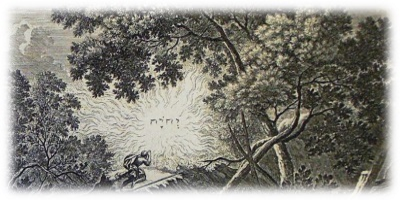
The Two Yahwehs at Passover
Let's start with the second part of Exodus 12:23.
...and when he seeth the blood upon the lintel, and on the two side posts, the LORD will pass over the door, and will not suffer the destroyer to come in unto your houses to smite you. (Exodus 12:23b)
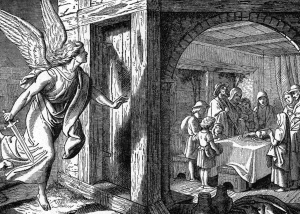
Who is the one who will prevent the “destroyer” from killing the first-born? I think we can all agree that it is Yahweh (written as “LORD” in most Bibles). Now let’s read the first part of this passage carefully.
For the LORD will pass through to smite the Egyptians... (Exodus 12:23a)
And also, this verse.
And it came to pass, that at midnight the LORD smote all the firstborn in the land of Egypt, from the firstborn of Pharaoh that sat on his throne unto the firstborn of the captive that was in the dungeon; and all the firstborn of cattle. (Exodus 12:29)
According to verse 23b, Yahweh will prevent the destroyer from entering homes with the blood on the lintel and posts, and verses 23a and 29 identify Yahweh as the destroyer. How is this possible?
Before we answer this question, let's look at another passage.
The Two Yahwehs at Sodom and Gomarrah
Then the LORD rained upon Sodom and upon Gomorrah brimstone and fire… (Genesis 19:24)
In Genesis 18:2-8 we read that three men approached Abraham an Abraham offers them rest, water and food.
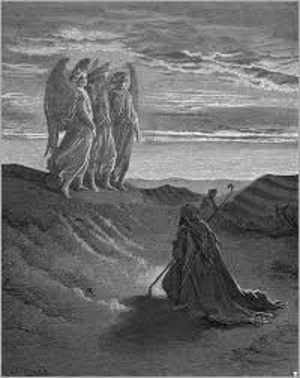
Then in verse 9 they ask him where Sarah is. In verse 10 one of them, which we discover in verse 13, is Yahweh, says that Sarah will have a child.
And the men turned their faces from thence, and went toward Sodom: but Abraham stood yet before the LORD. (Genesis 18:22)
Note that it just says “the men turned… and went toward Sodom.” It does not say how many of the men, but we can assume it is two, because the third man, the one identified as Yahweh, remains with Abraham.
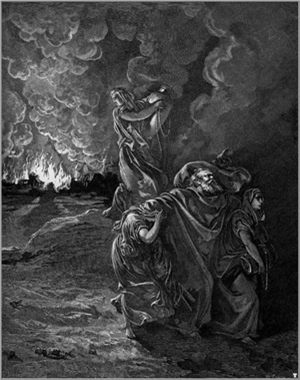
Over the remaining verses of Chapter 18, Abraham bargains with Yahweh for the lives in Sodom and then in verse 33 Yahweh leaves Abraham. Genesis 19:1-23 is the story of the two men that had previously left Abraham and are now with Lot and his family and facilitating their escape from Sodom.
Then, we read the following.
Then the LORD rained upon Sodom and upon Gomorrah brimstone and fire … (Genesis 19:24a)
We are not told where Yahweh came from, but we can assume he left Abraham and went to Sodom, just as the other two men had done previously. Upon arriving at Sodom, he destroyed it, along with Gomorrah, with brimstone and fire. And where did Yahweh get this brimstone and fire? Let’s read the rest of verse 24.
…from the LORD out of heaven; (Genesis 19:24b)
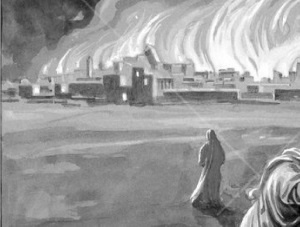
So, Yahweh got it from Yahweh. From the text, it would appear that there are two Yahwehs again, one on the ground and the other in the heavens?
The Two Yahwehs of the Journey in the Wilderness
And the LORD said unto Moses, Depart, and go up hence, thou and the people which thou hast brought up out of the land of Egypt, unto the land which I sware unto Abraham, to Isaac, and to Jacob, saying, Unto thy seed will I give it: (Exodus 33:1)
And I will send an angel before thee; and I will drive out the Canaanite, the Amorite, and the Hittite, and the Perizzite, the Hivite, and the Jebusite: (Exodus 33:2)
Unto a land flowing with milk and honey: for I will not go up in the midst of thee; for thou art a stiffnecked people: lest I consume thee in the way. (Exodus 33:3)
According to these verses, Yahweh is saying that he is not going to go with the Israelites to Promised Land, otherwise he will kill them. So he is sending an “angel” (again, in Hebrew, this word means “messenger.”) to go before them.
Yahweh repeats this in the following verse.
And he said, My presence shall go with thee, and I will give thee rest. (Exodus 33:14)
The Hebrew word for “presence” is paniym, literally meaning “face.” As Yahweh will not be going with Israel, he is sending his "face," which we can interpret to mean "messenger," will be going in his place.
However, throughout the narrative of the Israelites travels through the wilderness we are told time and again that Yahweh is with them. Apparently, the messenger sent my Yahweh, is Yahweh. Agin, we see two Yahwehs.
Two Yahwehs at the Burning Bush
Throughout Exodus chapter 3, we read that Yahweh spoke to Moses from the Burning Bush. The following verse is an example.
And the LORD said, I have surely seen the affliction of my people which are in Egypt, and have heard their cry by reason of their taskmasters; for I know their sorrows; (Exodus 3:4)
However, just prior to this, we read the following.
And the angel (messenger) of the LORD appeared unto him in a flame of fire out of the midst of a bush: and he looked, and, behold, the bush burned with fire, and the bush was not consumed. (Exodus 3:2)
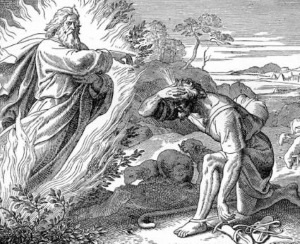
Again we find two Yahwehs, one identified as Yahweh and the other as the messenger of YHWH.
Two Yahwehs in Deuteronomy 29
Now let’s get to the heart of matter, to show that when Moses spoke it was Yahweh speaking. In order to do this, we will need to take a close look at the following passages from Deuteronomy 29.
1. These are the words of the covenant, which the LORD commanded Moses to make with the children of Israel in the land of Moab, beside the covenant which he made with them in Horeb.
2. And Moses called unto all Israel, and said unto them, Ye have seen all that the LORD did before your eyes in the land of Egypt unto Pharaoh, and unto all his servants, and unto all his land;
I think we can all agree that Moses is speaking to the Israelites about Yahweh.
3. The great temptations which thine eyes have seen, the signs, and those great miracles:
4. Yet the LORD hath not given you an heart to perceive, and eyes to see, and ears to hear, unto this day.
Again, I think we agree that Moses is still speaking.
5. And I have led you forty years in the wilderness: your clothes are not waxen old upon you, and thy shoe is not waxen old upon thy foot. 6 Ye have not eaten bread, neither have ye drunk wine or strong drink: that ye might know that…
Moses is still talking right? But now look at what Moses says next.
I am the LORD your God.
What is going on here? Apparently, Moses was so inseparable from Yahweh, and so inter-connected with him, that when he spoke, he was speaking the mind of Yahweh. He was a messenger of Yahweh. And he was not the only one, evidenced by, what appeared to be, the two Yahwehs we saw in the other passages in the Torah. Also, according to the Torah, there will be another one to come who would be just like Moses.
I will raise them up a Prophet from among their brethren, like unto thee (Moses), and will put my words in his mouth; and he shall speak unto them all that I shall command him. (Deuteronomy 18:18)
This may help to explain the meaning of the following passage from the book of John.
I and my father are one. (John 10:30)


The Way of Yahweh (Article)
In the Bible, the way to God is described as a journey, a path leading to a destination.
The Nature of God (Article)
The Hebraic perspective of God is a balance within the attributes of God.
The Image of God (Video & Article)
An examination of three passages that reveal the image of God and how our lives reflect on this image.